Features
Real tugs. Real ports. Real physics.
Built by mariners, for the people who do the job.
Features
Real ship handling
Physics from the published methods naval architects use. Push and pull act where they are applied.
Real tugs
ASD tug classes built from published data, including escort work with the keel hooked in.
Every major Australian port
Charted from official lists. Any port in the world on request, and a built-in chart editor to make your own.
Any conditions
Tide, wind, swell, rain and fog, from dawn to night.
Two seats, team jobs
Drive the tug or have the ship. Link stations for one pilot and a team of tug drivers.
No facilitator needed
On site, on a PC. Guided exercises, coaching after every run, and a training record for each trainee.
Full voice control
Talk to the pilot on the radio. VHF, engine and sea sound, and a clean run screen with bridge-style conning.
Your controls, your screens
ASD, traditional or custom joystick controls, on a single, ultrawide or multi-monitor set-up.
Training statistics · coming in 1.0.1
Training that shows you exactly what to work on.
Every run is measured against the limits a tug master or pilot already works to. There are no abstract scores. You see what happened, why it matters, and what to practise next.
Focus training
After every run, three coaching cards pick your weakest areas. Each says what went wrong and why it matters, gives one practical tip for the levers, and lets you replay the exact moment or start the drill built for that skill.
A routine that moves on
Your practice routine changes as you improve, so time goes where it counts.
A record you can show
Every run goes into a training record with the limits written on it.
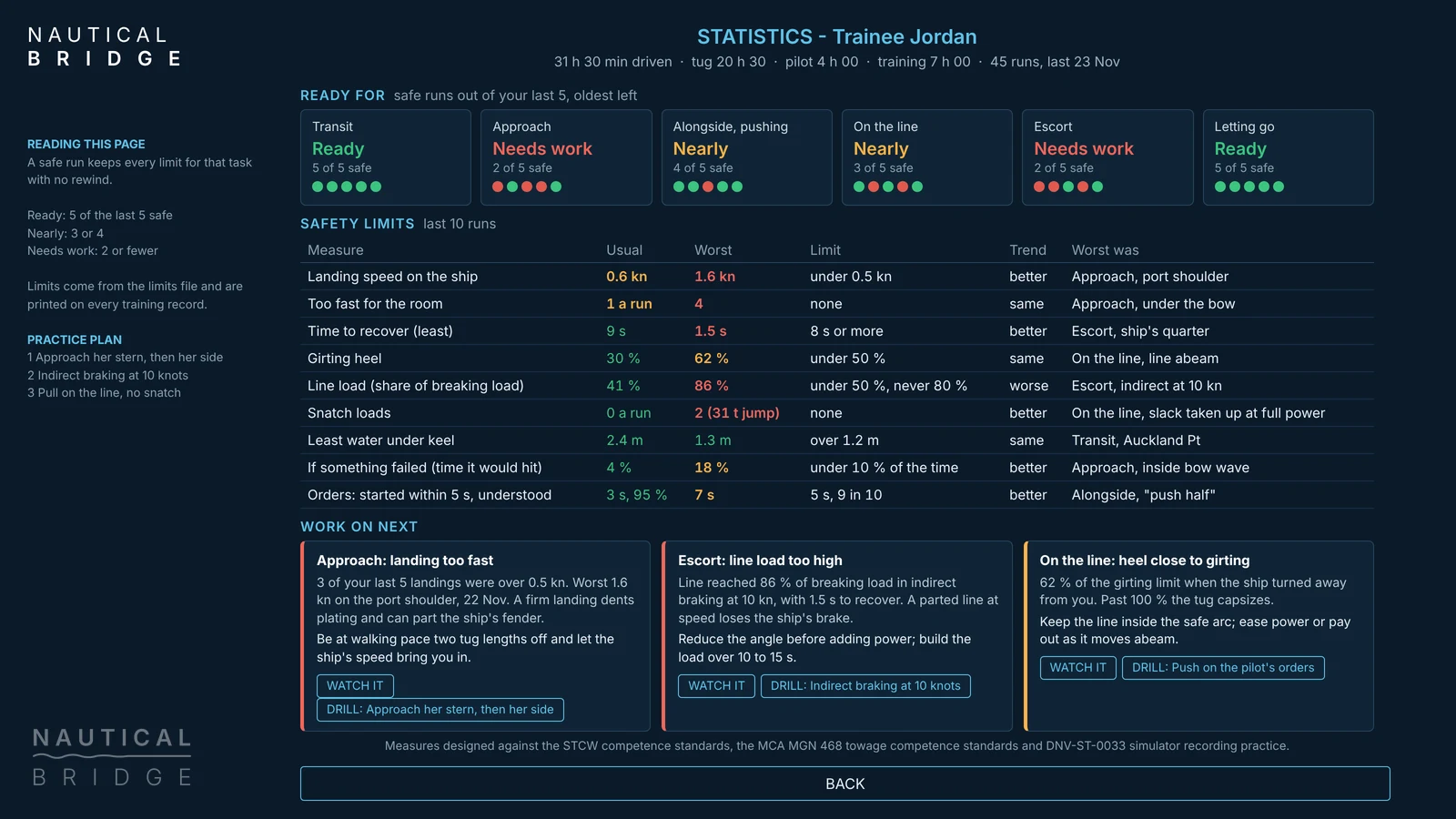
Measures designed against the STCW competence standards, the MCA MGN 468 towage competence standards and DNV-ST-0033 simulator recording practice.
On the run screen
Everything you need, nothing you don't
Interested?
Tell us about your operation and we will come back to you.